What Is Exhaust Gas Power Generation?
Many industrial processes produce exhaust or off‑gas streams that contain combustible components — including CO, H₂, CH₄, or other light hydrocarbons. If these gases are vented or flared, their energy content is wasted and harmful emissions may occur. An industrial exhaust gas generator captures such waste gases, performs pretreatment (filtering, moisture and contaminant removal), mixes the cleaned gas with air, and combusts it in a specially adapted lean‑burn engine. The resulting mechanical energy drives an alternator to produce electricity — effectively turning waste gas into useful power and reducing environmental footprint. :contentReference[oaicite:1]{index=1}
Why Use Exhaust Gas as Fuel?
Energy Recovery from Waste Streams: Utilizes waste gas that would otherwise be vented or flared, maximizing resource efficiency.
Cost Reduction: Replaces purchased fuel (e.g. natural gas or diesel), reducing energy procurement and waste‑gas disposal costs.
Environmental & Emission Benefits: Cuts greenhouse gas emissions and air pollutants by avoiding uncontrolled venting and making use of combustible waste gas.
Large‑Scale Power Supply: With 1200 kW output, the generator is suitable for heavy industries, large plants, or energy‑intensive operations needing stable power supply.
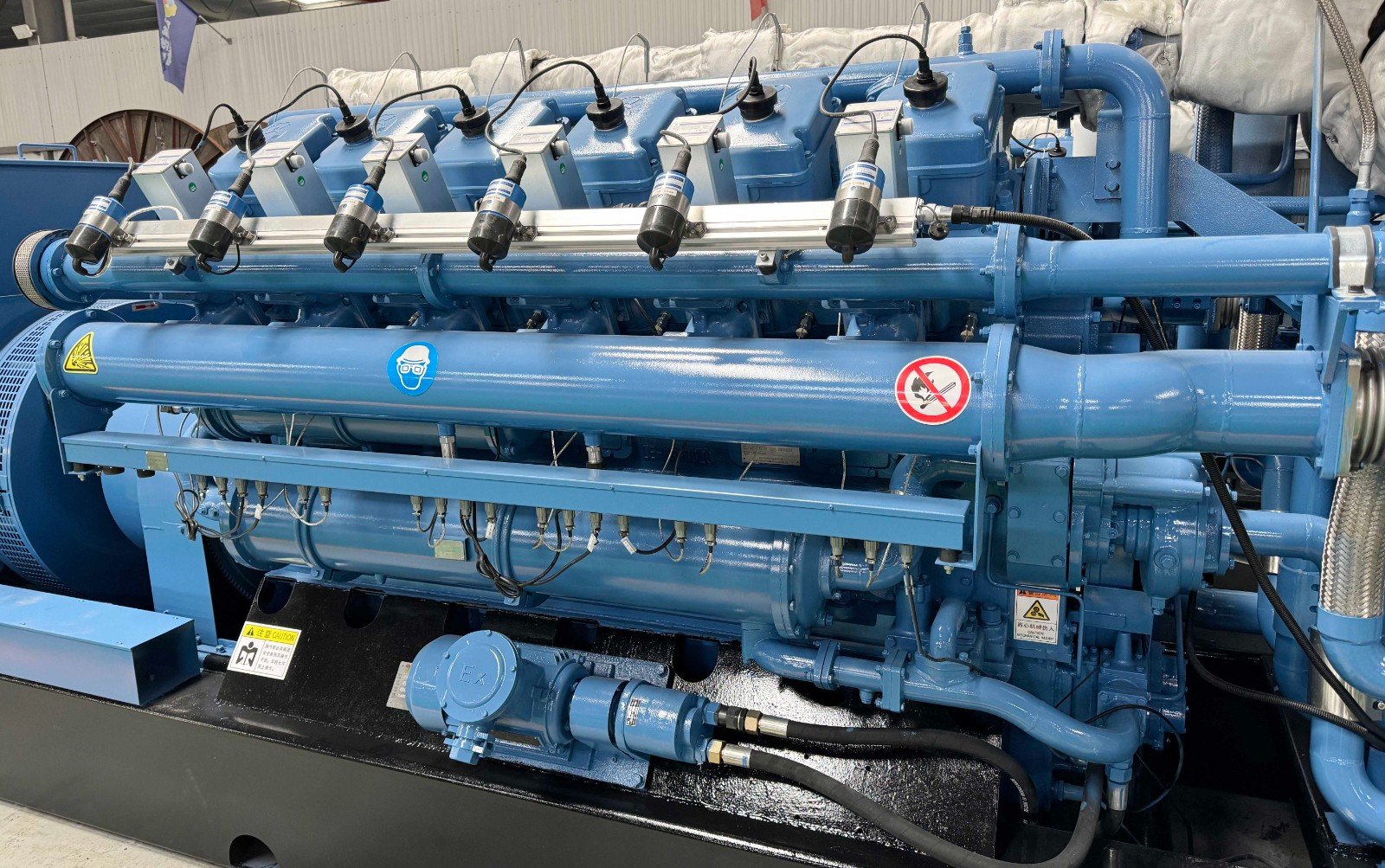
Introduction to Technical Features:
Turbocharging and shunt Intake technology:
Avoiding the generation of mixed gas, the gas and air enters the cylinder isolated with no contact. At the same time, the exhaust enery from the generator will be used for turbocharing the gas and air respectively. It realizes the improvement of intake and the synchronous improvement of operation power and volume power and ensures safety operation at the same time.
From 2018 till now, the safe stayale running time is more than 30000 hours. The measured electric efficiency is more than 40% in practice - 1m3 exhaust gas generates one kilowatt-hour of electricity.
There is no carbon monoxide leakage, no backfire and flash explosion, and the genset runs smoothly. Self consumption rate is less than 2%. The operation control of the genset is automatically adjusted with the change of gas.
Technical parameters:
| Model | CP22 | CP21 | CP11 | CP14 |
| CP1200GFJ22 | CP900GFJ21 | CP700GFJ11 | CP600GFJ11 | CP500GFJ11 | CP250GFJ14 | CP200GFJ14 |
| Electrical Output(kw) | 1200 | 900 | 700 | 600 | 500 | 250 | 200 |
| Electrical Efficiency(%) | 40 | 38 | 38 | 36 | 36 | 35 | 34 |
| Thermal Efficiency(%) | 44 | 45 | 45 | 44 | 43 | 44 | 43 |
| Total Efficiency(%) | 84 | 83 | 83 | 80 | 79 | 79 | 77 |
| Cylinder Number | 16 | 12 | 12 | 12 | 12 | 6 | 6 |
| Discharge(L) | 104.34 | 78.25 | 71.45 | 71.45 | 71.45 | 35.7 | 35.7 |
| Speed(r/min) | 1000 | 1200 | 1000 | 1200 | 1000 | 1200 | 1000 | 1200 | 1000 | 1200 | 1000 | 1200 | 1000 | 1200 |
| Frequency(Hz) | 50 | 60 | 50 | 60 | 50 | 60 | 50 | 60 | 50 | 60 | 50 | 60 | 50 | 60 |
| Length(mm) | 7409 | 6400 | 6300 | 6300 | 6300 | 4500 | 4500 |
| Width(mm) | 1822 | 1950 | 1950 | 1950 | 1950 | 1300 | 1300 |
| Height(mm) | 2325 | 2175 | 2175 | 2175 | 2175 | 2365 | 2365 |
| Weight(kg) | 19000 | 15000 | 14000 | 13500 | 13500 | 8400 | 7000 |
Technical & Operational Highlights of the 1200 kW Unit
Heavy‑Duty Gas Engine with Dual‑Intake + Turbocharging: Designed for industrial exhaust gas, ensuring safe combustion and mitigating risk of backfire or flash explosion — a proven technology also used in 500 kW series gensets.
High Electrical Efficiency: Around 40% under optimal conditions; typical overall energy utilization (with thermal recovery) can reach ~80–85%.
Wide Gas Compatibility: Supports a variety of industrial gases — furnace exhaust, kiln flue, synthesis gas, mixed waste gas — with adaptive gas‑air mixing and combustion control to handle fluctuations in calorific value and composition.
Continuous Heavy‑Load Operation: Engineered for 24/7 rated-load use, ideal for large plants needing uninterrupted power supply.
Optional Heat Recovery (CHP Mode): Exhaust heat and engine cooling heat can be recovered for hot water or steam supply, boosting overall energy efficiency — especially useful for industrial heating, process heating, or district heating applications.
Modular & Scalable Plant Design: Suited for standalone installation or multi‑unit parallel configuration, enabling flexible capacity scaling and redundancy building.
Cost‑Effective & Environmentally Responsible: By substituting purchased fuel and turning waste gas into power, enterprises can reduce both energy and waste treatment costs, reduce emissions, and improve sustainability credentials.
Technical Specifications (Typical)
| Item | Specification / Notes |
|---|
| Rated Electrical Output | 1200 kW |
| Engine Type | Industrial lean‑burn gas engine (dual‑intake, turbocharged) |
| Fuel / Gas Source | Industrial exhaust gas / off‑gas / flue gas (containing CO, H₂, CH₄, hydrocarbons) |
| Electrical Efficiency (typical) | ≈ 40% |
| Total Energy Utilization (with Heat Recovery) | ≈ 80–85% |
| Gas Supply Condition | Low–medium pressure after pretreatment & regulation |
| Combustion Control | Adaptive ECU: ignition timing, knock detection, mixture compensation |
| Operation Mode | Continuous rated‑load / Base‑load / Parallel multi‑unit mode |
| Optional Modules | Heat‑recovery (hot water / steam), remote monitoring, synchronization kit, soundproof container, grid‑connection package |
Gas Pretreatment & Safety Recommendations
To ensure long-term stable and safe operation, the following pretreatment is strongly recommended before the exhaust gas enters the generator:
Dust and particulate filtration — to prevent engine fouling and abrasion
Moisture removal / condensate separation — avoid water ingress
Tar / volatile organic compounds (VOC) removal — if waste gas contains hydrocarbons
Gas desulfurization (H₂S / sulfur compounds) — to protect internal components from corrosion
Pressure regulation and safety valves — to maintain stable fuel supply
Flame arrestors & automatic shutdown mechanisms — to ensure safety in abnormal conditions
Typical Industrial Application Scenarios
Metallurgical plants & smelting furnaces — using furnace off‑gas for on‑site power and heat supply.
Coke oven plants — converting coking gas into electricity and process steam/hot water.
Cement, lime, or kiln-based factories — recovering kiln flue gas energy, reducing fossil fuel consumption.
Chemical, petrochemical, refinery facilities — using process off‑gas or by‑product gas for power generation.
Waste gas recycling & emission treatment plants — turning waste emissions into value, reducing pollution.
Large-scale distributed power / cogeneration (CHP) plants — supplying both electricity and thermal energy to industrial complexes, district heating systems, or combined industrial processes.
Economic & Environmental Benefits
By installing the 1200 kW Exhaust Gas Generator, enterprises can expect:
Significant reduction in energy procurement cost: Waste gas replaces purchased fuel, cutting or eliminating fuel costs.
Reduced emissions and waste‑gas treatment cost: Exhaust gas is utilized instead of vented or flared, cutting greenhouse gas emissions and air pollutants. :contentReference[oaicite:10]{index=10}
Improved energy utilization efficiency: With heat recovery, overall energy utilization rate reaches 80–85%.
Enhanced sustainability and ESG credentials: Supports circular economy, waste-to-energy, and industrial emission reduction targets — increasingly valued under environmental regulations and corporate responsibility requirements.
Stable on‑site power supply & energy security: Reduces dependence on external fuel supply or unstable grid, especially for remote plants or heavy-load operations.
Operation & Maintenance Guidelines
Regular maintenance of gas pretreatment components (filters, moisture traps, tar scrubbers, desulfurization units).
Periodic inspection of ignition system, gas mixture control, knock detection, valves, and spark plugs — especially if gas composition varies.
Maintenance of exhaust and safety systems — including flame arrestors, pressure relief valves, and exhaust handling to ensure safe emissions.
If heat‑recovery (CHP) module installed — regular inspection and maintenance of heat exchanger, condensate management, steam/water circuit, and corrosion prevention.
For multi‑unit or parallel installations — periodic synchronization tests, load sharing check, and redundancy verification.
Frequently Asked Questions (FAQ)
Q: What kinds of waste / exhaust gases are suitable for the 1200 kW generator?
A: Gases containing combustible components — such as furnace off‑gas, kiln flue gas, synthesis off‑gas, CO / H₂ / CH₄-rich mixtures, or mixed process waste gas — are suitable, provided proper pretreatment (dust, tar, moisture, corrosive components removed) is applied.
Q: What is the minimum gas calorific value required?
A: Typically ≥ 1.5 MJ/Nm³ after pretreatment and regulation. However, stable operation depends on gas composition, flow rate, pressure and pretreatment quality.
Q: Can this system operate continuously under heavy load 24/7?
A: Yes. The engine and genset are specifically engineered for continuous heavy‑load operation in industrial environments, offering high reliability and long service life.
Q: Can the system support combined heat and power (CHP)?
A: Yes. With the optional heat‑recovery module, exhaust and engine cooling heat can be recovered for hot water or steam supply, boosting overall energy utilization efficiency to ~80–85%.
Q: Can multiple 1200 kW units operate in parallel for larger capacity or redundancy?
A: Yes. The system supports modular parallel operation with synchronization control, enabling flexible scaling and redundancy to meet large‑scale power demands or ensure backup.
Contact Us for a Fully Customized Exhaust‑Gas Power Solution
We provide full turnkey solutions: from waste‑gas analysis, pretreatment system design, generator supply, heat‑recovery integration, installation and commissioning to long‑term technical support and maintenance.
Contact us today to design a 1200 kW exhaust‑gas generator package tailored to your gas composition, load profile, and site requirements. Maximize waste‑gas value and improve your plant’s energy efficiency and environmental performance.


