A steel plant does not draw the same power at 2 a.m. as it does during a shift change. A cable line will not tolerate the voltage dip of a 400 kW motor starting. And no production manager wants to stop the plant because one engine is due for an oil change.
Those three problems — variable load, motor starting and maintenance — are exactly what parallel natural gas generator sets are built to solve. Instead of sizing one large machine for a peak that lasts a few hours a day, a factory can run several synchronized sets on a common busbar: bring units online as demand rises, take them off when it falls, and service one engine while the rest keep producing.
Engineered properly, that arrangement improves power availability, cuts unnecessary running hours and leaves room for the next production line. It also changes how the plant's electrical system has to be designed — which is what the sections below address.
No two production lines draw power the same way. A steel processing line starts heavy motors and rides through current spikes. A cable manufacturing line needs a flatter, more predictable supply. Compressors, cooling systems, pumps and lighting add a base load that never quite disappears.
A single oversized generator struggles with that mix. Run it at 30–40% of rating for most of the day and the engine operates outside the range its manufacturer designed it for. Run several smaller sets in parallel and the load can be divided according to each unit's rating and the configured control strategy, so the machines actually in service are the ones doing useful work.
With a synchronizing and load-sharing system, the generators connect to one busbar and divide both active and reactive power according to the system design.
Take a plant with four 500 kW natural gas generator sets — 2 MW of combined rated capacity, the same four-unit arrangement EN ENERGY supplied for a 2 MW Deutz power plant. How many units run at any moment follows the plant's demand, its operating reserve policy and the rating of each machine.
When a furnace restarts and demand climbs, the controller starts another set, synchronizes it with the running units and shares the additional load. When the night shift ends and demand falls, one unit is unloaded and stopped once the shutdown conditions and cool-down delays are met.
For steel and copper plants, cable factories, manufacturing workshops and industrial parks — sites where different processes have different consumption patterns — that flexibility is the difference between a power plant that follows production and one that production has to work around.
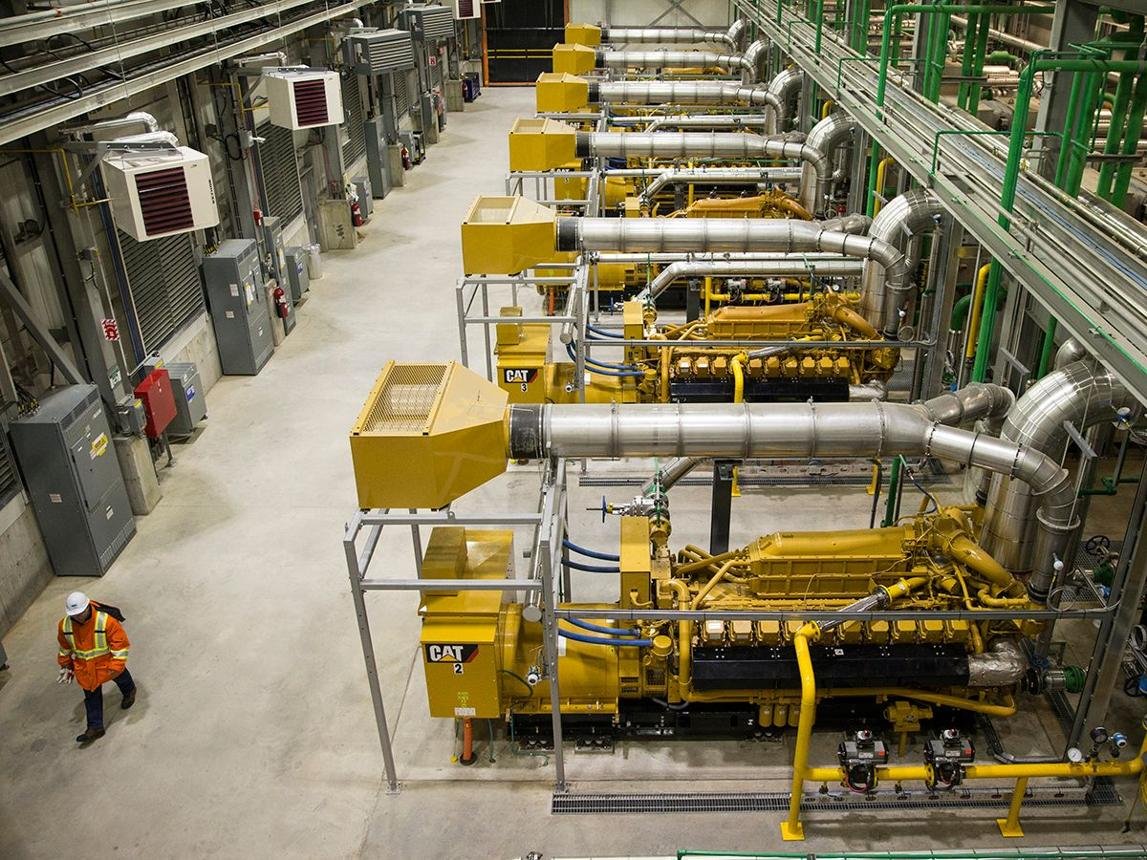
Electricity is not just a line item for an industrial facility. An unplanned interruption stops production, pushes delivery dates, disturbs process temperatures and can cost hours of restart time.
Parallel operation changes the maintenance equation: servicing can be planned around the generation capacity still available, rather than around a full plant shutdown.
A plant with four 500 kW sets needs 1.2 MW during a service window. Three units can carry that load while the fourth is isolated — provided the remaining machines can hold the actual load plus the reserve the site requires. The service itself covers lube oil and filter replacement, inspections, ignition system work, cooling system checks and whatever else the engine manufacturer specifies.
Before a set is taken offline, the operator confirms the available capacity of the remaining units, transfers or trims load where needed, and isolates the machine under the approved electrical and mechanical safety procedure. Planned work then fits around production instead of replacing it.
The limitation deserves stating plainly: parallel operation does not guarantee continuity on its own. If the remaining sets cannot carry the critical load, the plant has to reduce output, transfer load to another source or install standby capacity. Sites with high availability requirements usually move to an N+1 configuration, where installed capacity still covers the defined load with one machine out of service. The same principle scales down: a 1 MW two-set parallel system gives a smaller plant the same maintenance freedom.
Factory demand rarely holds steady. Some lines run continuously, others batch, and startups swing the total sharply.
Keeping every generator running when only part of the installed capacity is needed wastes fuel and service hours. A properly configured automatic control system starts units as demand rises and stops them as it falls — generator staging, or load-based dispatch.
Four 500 kW sets, 2 MW combined:
These numbers illustrate the logic; they are not controller setpoints. Real dispatch depends on each set's continuous rating, minimum recommended load, transient performance, site derating, reserve requirement and load profile.
The aim is not to run the fewest engines possible. It is to keep every running engine inside a healthy loading band while holding enough capacity to absorb the next change in demand.
Plants with heavy motor loads should also weigh starting current, starting sequence, voltage dip, frequency recovery and how quickly the generator control system responds.
One large generator is one point of failure. If it trips, everything downstream goes dark unless another source is already connected and ready.
A multi-unit system spreads generation across several machines. When one faults, the control system disconnects the affected set and lets the healthy units carry what they can support. Critical facilities can go further and prioritize essential circuits — control systems, safety equipment, selected pumps, key production machinery.
How much load actually survives depends on remaining capacity, protection settings, fault characteristics, and the time needed to shed load or start another unit.
Connecting several engines to one busbar does not by itself produce a reliable system. The design has to cover:
Shared equipment can become the single point of failure. A common gas supply, a switchgear section or one control system deserves the same scrutiny as the generators themselves. In demanding environments — the Middle East, parts of Central Asia — site temperature, altitude, dust, gas quality and installation conditions all have to enter the calculation.
A plant that runs year-round needs a power solution built around its operating schedule, not only its highest load hour.
Natural gas generator sets suit 24/7 duty where the gas supply is reliable and production needs long, predictable running hours. For projects in the UAE, Iran, Russia, Kazakhstan or Ukraine, the configuration has to follow local grid conditions, fuel availability, ambient temperature, voltage and frequency requirements, and the applicable emissions and electrical standards.
The gas source usually shapes the design more than the map does. Two reference projects show the spread: a 10 MW shale gas power plant in Chongqing running on associated gas, and an 11 MW LNG power station in Xinjiang built alongside a 500,000 m³/day liquefaction plant.
Continuous operation does not mean running every set at 100% around the clock. The right band comes from the engine manufacturer's specification and the project's load profile.
Sustained operation below the recommended minimum load can lead to incomplete combustion and deposits; running permanently near maximum leaves no headroom for load steps and adds thermal stress. Both shorten the working life the plant paid for.
That is why EN ENERGY reviews normal load, peak load, motor starting demand, maintenance requirements and expansion plans before selecting ratings — then sets an operating strategy that keeps online units inside their recommended band with reserve left over.
Parallel generation fits industrial users that need flexible capacity, planned maintenance without avoidable interruption, or room to grow generation as demand rises. It tends to be a strong option for:
A single set can still be the more economical answer for a small plant with a stable load and acceptable maintenance downtime. The decision turns on load profile, required redundancy, fuel conditions, capital budget and expected operating hours.
Before a proposal is prepared, the engineering team needs the total connected load, simultaneous demand, largest motor starting requirement, voltage, frequency, gas composition, gas pressure and expected maintenance schedule. Those figures determine how many sets, at what rating, with which control system and how much reserve.
EN ENERGY builds and supports gas engines and gas generator sets for industrial power, with a range from 5 kW to 3 MW and configurations across the EN, Deutz, MWM, Perkins and Steyr engine series.
For factories that need coordinated load sharing, flexible capacity and long-term reliability, we configure parallel systems with containerized sets, Comap, DEIF or DSE master controllers, and the protection and load-management logic the site requires. Our project experience covers oil and gas field power, wellhead associated gas, CNG and LNG plants, and continuous-process industrial users.
Whether you are building a new industrial power plant, replacing an existing generator system or adding capacity to a running factory, our engineers can assess the options with you.
Contact EN ENERGY with your factory's load requirements to request a customized parallel natural gas generator set proposal.
How many generator sets do I need in parallel?
Enough to cover the defined load with the reserve and redundancy the site requires — commonly three to five units. The count follows the load profile, motor starting demand and maintenance strategy rather than a fixed rule.
Can a parallel system keep the plant running during maintenance?
Yes, when the remaining units can carry the critical load plus reserve. That has to be checked unit by unit before any set is isolated, and N+1 capacity turns it into a designed condition rather than a hope.
Does every unit run at full load?
No. Units are staged in and out so the running sets stay inside their recommended loading band — which is the whole point of load-based dispatch.
Inquiry Now

Longcheng Road 31, Building 3, Qingdao City, Shandong Province
© 2025 Qingdao En Energy Technology Co., Ltd All Rights Reserved.
Powered by HiCheng

