Electricity has quietly changed categories: from an operating expense to a strategic resource that decides whether a factory can expand, whether a data center can promise uptime, and whether an industrial park can attract tenants at all. As global consumption keeps climbing, natural gas power plants and gas generator sets are drawing attention from a widening circle of investors — data center operators, industrial park developers, factory owners and independent power producers.
The shift is most visible where gas is available but grid electricity is expensive, unreliable or simply insufficient. There, generating power on site is no longer a hedge; it is a business decision with numbers behind it.
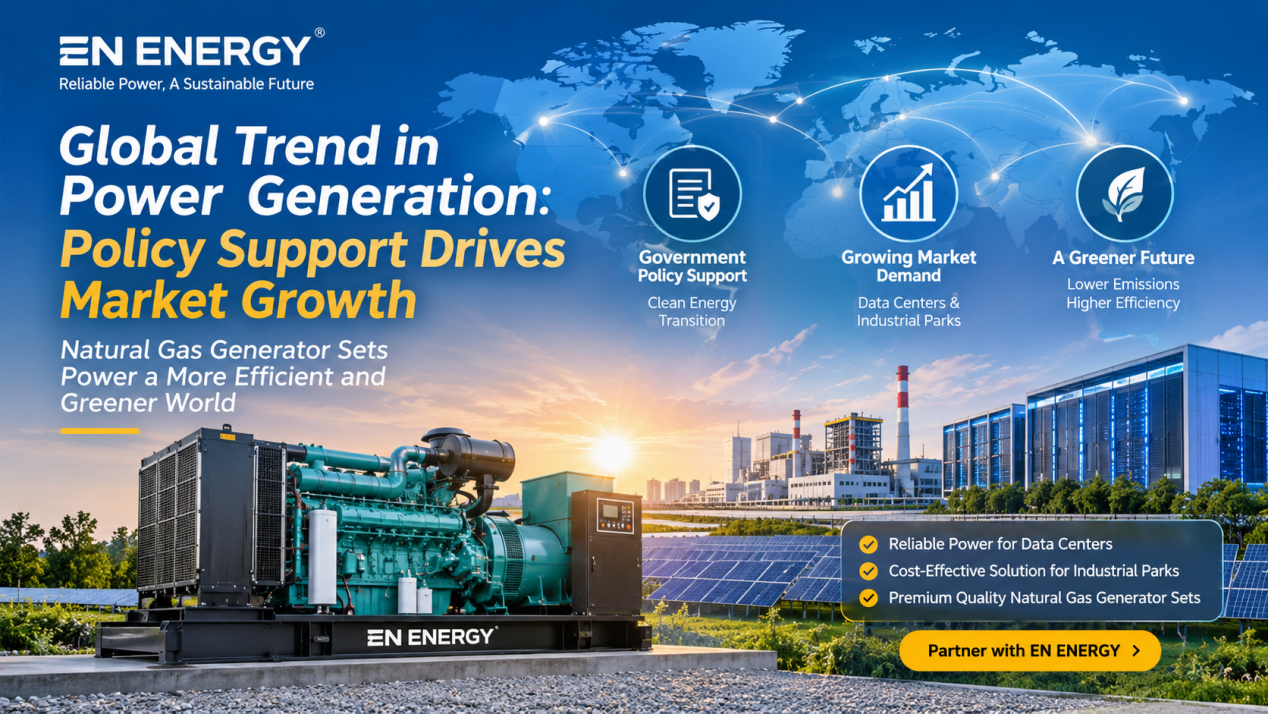
According to the International Energy Agency (IEA), global electricity demand is forecast to grow an average of 3.6% annually between 2026 and 2030, driven by industrial electrification, artificial intelligence, data centers, electric vehicles and rising cooling demand. Energy-intensive industries are expanding faster than the infrastructure meant to serve them.
For businesses planning long-term operations, the question is changing — from "How much electricity can we buy?" to "How do we secure a reliable, economically competitive supply?"
AI, cloud computing and digital infrastructure have created electricity consumers unlike anything the grid was built for. Data centers need continuous power for servers, cooling and networking — and they measure interruptions not in lost hours but in damaged equipment, lost data and broken service commitments.
The IEA estimates that electricity generation supplying data centers could rise from roughly 460 TWh in 2024 to more than 1,000 TWh by 2030 in its base-case scenario. That trajectory is opening several supply paths:
For large data center projects, a natural gas generator engineered for 24/7 operation fits into the wider energy strategy wherever grid expansion takes years or reliability requirements exceed what the network can promise.
Steel, copper processing, cement, chemicals and mining all consume electricity at a scale that grows faster than local grids can follow. Companies in expanding industrial regions face a familiar list: limited grid connection capacity, rising tariffs, unstable supply, high peak-demand charges, years-long waits for grid expansion, and production losses whenever the network fails anyway.
An independent industrial park power generation project answers that list directly. For park developers, a centralized gas plant distributing power to multiple tenants can even become a long-term energy service business — subject to local licensing and electricity market regulations.
The energy transition is not phasing out conventional generation; it is diversifying it. Gas remains the dispatchable complement to variable renewables — and several markets are now actively building capacity around that fact.
United Arab Emirates. The updated UAE Energy Strategy 2050 aims to triple renewable contribution by 2030 and mobilize AED 150–200 billion in energy investment through 2030–2031, while encouraging private participation in the power market. Growing investment in AI, cloud and industrial facilities adds further demand. For investors evaluating natural gas power plant projects in the UAE, the opportunity is gas generation that complements renewables and provides dispatchable capacity for industry.
Kazakhstan. The government's energy development plan through 2035 includes more than 26.3 GW of additional generation projects, alongside expanding gasification programs. In 2026 Kazakhstan introduced a 70/30 investment mechanism for power plant modernization: up to 70% of new capacity can be sold directly to major consumers — including data centers and digital mining operations — with the remaining 30% to the national system. It is a concrete model of private investment meeting industrial demand.
Other energy-intensive markets. Russia's long-term energy strategy to 2050 cites rising domestic electricity demand, including from data centers. In Iran and similar markets, industrial supply, local fuel availability and grid reliability drive independent generation. Ukraine and other markets modernizing infrastructure may consider decentralized generation as part of resilience planning. Policies on gas supply, private generation, electricity sales and grid connection differ by country — investors should confirm licensing, tariff and technical requirements before committing.
The direction across all of them is consistent: electricity security, capacity expansion and energy diversification are rising investment priorities.
Buying electricity from the grid is convenient — when prices are competitive and supply is stable. For businesses with high, continuous consumption, however, full dependence on purchased power is not automatically the economical choice. A properly designed captive power plant lets a company control part of its supply and reduces exposure to the external power market.
Gas power economics track fuel price. A plant near a gas pipeline buys fuel at stable, competitive rates. Oil and gas fields can convert associated gas into electricity instead of flaring it, where permitted. Biogas projects fuel themselves from agricultural waste, livestock manure, food processing waste and wastewater treatment. When fuel cost per generated kWh undercuts the total cost of purchased power, self-generation pays back over the plant's entire operating life.
An unexpected outage means interrupted production, lost material, stalled equipment and missed deadlines. Depending on design, a gas power plant can supply factory loads directly, run in parallel with the grid, cover peak demand, hold essential loads through grid disturbances, and coordinate with backup generators and storage. For round-the-clock factories and mining operations, that control is the product.
For some investors, electricity is not for internal consumption at all. An independent power producer (IPP) can build a plant and sell power where regulation permits: a centralized plant serving an industrial park, supply to multiple factories under an approved arrangement, a plant built beside a large consumer under a long-term power purchase agreement, or associated gas and biogas projects generating for sale. Modular staging — start at 2 MW, expand to 5 or 10 MW as customers sign — keeps initial capital in check. Profitability then depends on selling price, fuel cost, utilization, financing, maintenance and local rules.
Data centers demand more from a power system than almost any other modern load: continuous servers, cooling, distribution and emergency protection. Gas generator sets serve as on-site generation, standby supply or supplementary capacity. For large projects, multiple sets run in parallel to raise capacity and flexibility — and a modular arrangement lets operators start or stop individual units as the data center itself expands in phases.
Parks contain factories with different schedules and load patterns; a centralized gas plant serves them all and manages capacity against combined demand. A 4 MW plant, for example, can be configured as eight 500 kW sets in parallel — running count adjusted to consumption, maintenance and strategy. Against one large machine, multi-unit configuration offers flexible load management, easier maintenance scheduling, partial supply during unit maintenance, staged expansion and better adaptation to changing demand. At substantial capacity, medium-voltage distribution becomes worth evaluating to cut current and cable requirements.
IPP projects design the plant around expected demand, fuel conditions, grid connection and the electricity sales agreement. Modular investment reduces the initial commitment while leaving room to grow — but returns depend on tariff, fuel cost, utilization, financing, transmission charges and regulation, all of which belong in the feasibility study.
Choosing equipment for a power plant is not about picking a kilowatt number. The set must match the load profile, fuel composition, ambient conditions and expected operating hours.
The honest answer: it depends on the local energy market and the project's operating conditions. A serious assessment covers all of it, not just the fuel line:
| Cost item | Key considerations |
|---|---|
| Natural gas cost | Price per Nm³ and gas quality |
| Fuel consumption | Generator efficiency and operating load |
| Equipment investment | Generator sets, control system, auxiliaries |
| Installation | Civil works, electrical connection, commissioning |
| Operation and maintenance | Spare parts, labor, scheduled maintenance |
| Grid connection | Transformer, switchgear, protection |
| Financing | Interest, depreciation, payback period |
| Electricity revenue | Selling tariff and power purchase agreement |
A first-pass fuel cost check:
Fuel cost per kWh = gas consumption per kWh × gas price per Nm³
Example: a genset consuming 0.30 Nm³ per kWh at USD 0.20/Nm³ produces fuel cost of USD 0.06/kWh. That is fuel alone — maintenance, depreciation, installation, financing and other operating costs must be added before comparing against grid tariffs. If the full levelized cost of the plant undercuts comparable grid electricity, self-generation is economically attractive. For large projects, commission a feasibility study comparing capacities, fuel prices, annual running hours and expected tariffs before committing capital.
These answers determine whether the project takes one large generator, multiple smaller units, or a staged modular plant. Our reference projects show the range in practice: a 10 MW shale gas power plant in Chongqing and an 11 MW LNG power station in Xinjiang were each configured around exactly these questions.
EN ENERGY develops and supplies gas engines and gas generator sets from roughly 50 kW to 3 MW, fueled by natural gas, biogas, associated gas and other gaseous fuels. Output voltage configurations include 400 V, 440 V, 600 V, 6 kV and 10.5 kV, and multi-unit plants — such as our 2 MW four-set Deutz installation — demonstrate the parallel approach at scale, as covered in our factory parallel generation guide.
One positioning note matters more than any specification: natural gas power generation is not necessarily a replacement for the grid. It is an additional — and often more economical — supply option for businesses seeking energy independence, reliability and long-term cost control. Our engineering team assists with generator selection, gas condition assessment, parallel operation planning, electrical configuration and project-specific proposals.
If you are an industrial investor, EPC contractor, park developer or independent power producer, bring us the parameters: required capacity, gas conditions, operating hours and supply plan. Contact the team at www.en-generator.com — reliable gas power generation for a more independent energy future.
Inquiry Now

Longcheng Road 31, Building 3, Qingdao City, Shandong Province
© 2025 Qingdao En Energy Technology Co., Ltd All Rights Reserved.
Powered by HiCheng

