1MW Silent smoke collection type:

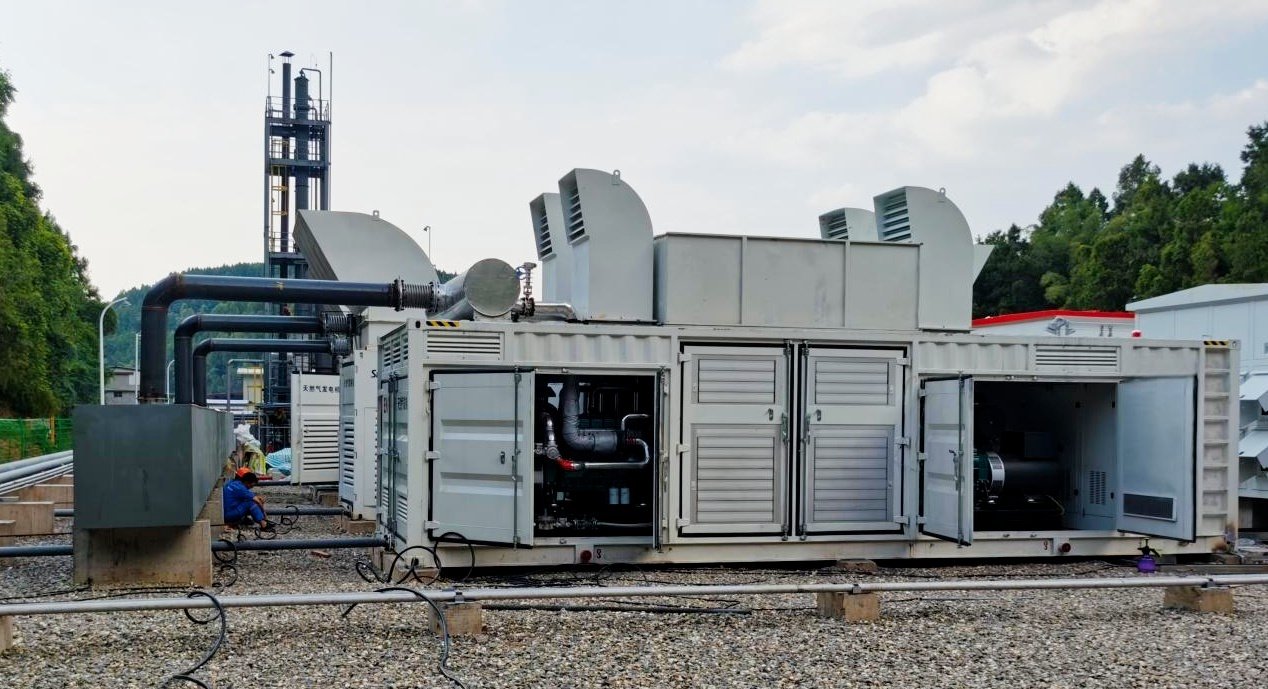
Combined heat and power (CHP) units, also known as "combined cycle CHP" or simply "CHP," operate on the principle of simultaneously producing both heat and electricity from a single energy source, thus significantly improving energy efficiency (up to 80%-90%), far exceeding the efficiency of traditional separate heat and power generation (approximately 40-50%).
Its core advantages are high energy efficiency, low operating costs, and adaptability to various gaseous fuels (natural gas, biomass gas, coalbed methane, biogas, etc.).
The following are their main application areas:
1. Industrial Sector
This is the largest and most traditional application area for CHP. Many industrial processes require large amounts of process heat and a stable supply of electricity.
Chemical Industries: High-pressure steam is needed for reactions, heating, distillation, etc., while a stable power supply is required to drive equipment.
Paper Industry: Large amounts of steam are needed in the papermaking process for drying pulp and paper.
Food and Beverage Processing Industry: Steam is needed for cooking, sterilization, disinfection, cleaning, and drying.
Textile printing and dyeing, rubber, and building materials companies:Requires steam and hot water for dyeing, finishing, and drying processes.
Metallurgy, metal processing and casting: Requires heat energy to power furnaces and heat treatment equipment.
Pharmaceutical Industry: Requires high cleanliness and stability of steam for production processes and sterilization.
2. District Heating and Cooling
In urban planning, this provides centralized heating and domestic hot water to a specific area (such as residential areas, commercial districts, or university campuses).
District Heating: In many northern cities, large-scale combined heat and power (CHP) units have replaced scattered small boilers, providing stable and clean heating and domestic hot water to the entire area, resulting in significant energy-saving and environmental benefits.
District Cooling: Utilizes electricity generated by CHP to drive absorption chillers or electric chillers to provide cooling to buildings during the summer, achieving efficient year-round energy use.
3. Commercial and Public Buildings
These buildings have a strong simultaneous demand for electricity and hot water.
Hospitals: Require 24/7 uninterrupted power to ensure life support systems, and also need large amounts of steam and hot water for disinfection, laundry, kitchens, and heating.
Universities and Schools: Campuses have classrooms, dormitories, laboratories, gymnasiums, etc., with large and concentrated demands for electricity and heating/hot water.
Hotels and Large Shopping Malls: Require electric lighting and air conditioning, as well as large amounts of domestic hot water, laundry steam, and winter heating.
Airports, Train Stations, and Data Centers: These are major energy consumers with extremely high requirements for power supply reliability, and also have continuous heating/cooling needs.
4. Agriculture and Greenhouses
Heat energy can be used for processes such as heat preservation, drying, and cooking.
Biogas power plants (livestock and poultry manure fermentation gas)
Greenhouses (CO₂ fertilization + heating)
Agricultural processing enterprises
5. Oil and Gas Industry
Especially suitable for oil and gas field scenarios with dispersed gas sources but high energy consumption.
Associated gas power generation in oil and gas fields
Natural gas processing plants
CNG/LNG plants
Well site self-use power generation and heating systems
6. Municipal and Environmental Protection Projects
In environmental protection projects, combined heat and power (CHP) can improve resource utilization efficiency.
Landfill Gas Power Plant
Biogas Utilization from Wastewater Treatment Plants
Waste Heat Recovery Projects
Cogeneration units are suitable for almost all industries that require both electricity + heat, and are particularly suitable for high-energy-consuming industrial enterprises, district heating systems, commercial buildings, and oil and gas and environmental protection energy projects.
Therefore, its application areas can be summarized as follows: Any place requiring stable and continuous heat and electricity is an ideal application area for CHP.
It not only saves users considerable energy costs but also has significant strategic importance for national energy conservation and emission reduction, and for achieving "dual carbon" goals.
Inquiry Now

Longcheng Road 31, Building 3, Qingdao City, Shandong Province
© 2025 Qingdao En Energy Technology Co., Ltd All Rights Reserved.
Powered by HiCheng

